


FSC/Jonathan Perugia
The UK is the second largest timber importer in the world, consuming millions of cubic metres of timber every year, around two-thirds of which is imported (TDUK). Most of this timber will be used by the construction industry, both in new projects and for repair, maintenance and improvement.
In March 2025 the UK government published the Timber In Construction Roadmap. The government has committed to “building 1.5 million homes over this Parliament (DEFRA, 2025).” which “provides an opportunity to grow demand for safely using timber in construction (DEFRA, 2025).”
Forests are incredibly valuable, not only for the survival of people but for the rest of the planet. Healthy, resilient forests are one of the most effective ways to combat climate change. Forests are incredibly diverse ecosystems, home to two thirds of biodiversity on land, but they, and the species which rely on them, continue to be threatened by deforestation and forest degradation.
It is important for timber and wood products to be sourced from forests where sustainable management ensures that trees are harvested in ways that prevent deforestation and protect vital ecosystems. These forestry practices safeguard biodiversity by maintaining habitats for plant and animal species, while also upholding fair working conditions through proper training, safety measures, and fair wages for forest workers.
Increasingly, businesses are working to make their supply chains more sustainable. Drivers of responsible sourcing of our planet’s ecosystem services are varied and include growing consumer demand for proof of ethical sourcing without greenwashing, and an increasing requirement to address deforestation which directly links to climate change and biodiversity loss. The European Anti-Deforestation Regulation, EUDR, anti-greenwashing laws within the Empowering Consumers Directive 2024 and the UK’s consumer protection laws all address transparent disclosure and compliance. Non-compliance risks reputations and can result in costly fines.
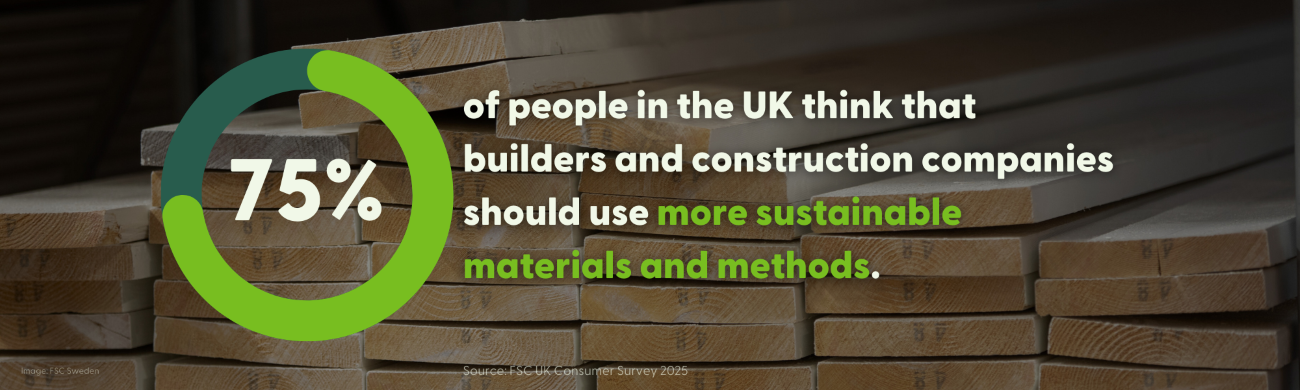
FSC certification is a proven method to help industries ensure healthy, resilient forests for generations to come. FSC-certified forests are managed to the highest environmental and social standards, supporting long term forest health and contributing to a more sustainable future. FSC-certified products can only contain forest-based materials that are from FSC-certified forests, and/or from reclaimed or controlled sources.
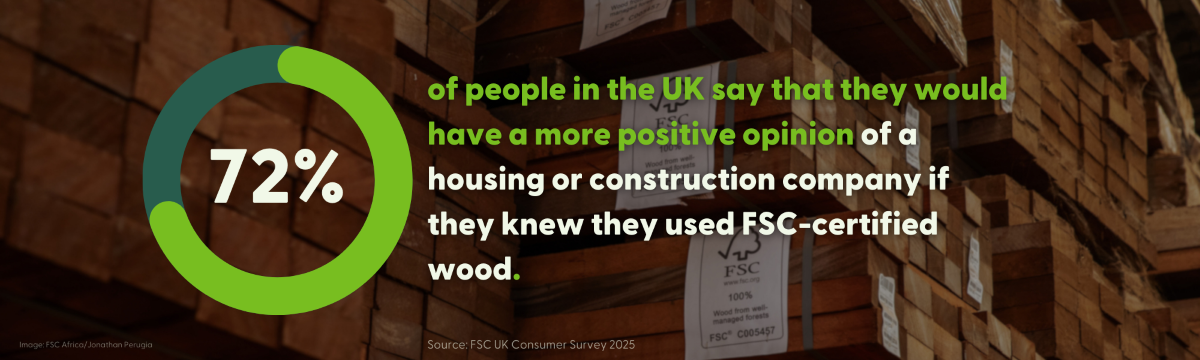
Many green building initiatives around the world recognise the value of FSC-certified materials. Operating internationally, both the Building Research Establishment Environmental Assessment Method (BREEAM), and Leadership in Energy and Environmental Design (LEED) award credits for the use of FSC-certified timber.
BREEAM awards credits for responsibly sourcing construction products (typically under the Mat 03 issue) to encourage responsible product specification and procurement in construction. FSC is a BREEAM-recognised Responsible Sourcing Certification Scheme (RSCS). Under the US Green Building Council's LEED v5 Materials & Resources standards, eligible FSC 100% and FSC Mix products score highest under the multi-attribute scoring methodology.
The UK harvests roughly 10 million green tonnes of softwood and 1 million green tonnes of hardwood each year. In 2024, 82% of sawmills’ roundwood consumption was certified.
Sourcing UK homegrown timber like Douglas Fir, Oak and Larch can support companies to reduce their carbon footprint. Timber from local forests within the UK used for construction projects can lower the project’s emissions and lead times whilst supporting jobs within the UK.
Forest habitats that are well managed within the UK can be biodiverse as well as productive, protecting vital ecosystem services such as clean air and water and healthy soils. FSC Forest Management certification ensures forests are managed to strict environmental, social and economic standards. FSC-certified timber and timber-products can be sourced from FSC certificate holders.
Tropical forests are home to two-thirds of the world’s biodiversity, including thousands of different tropical tree species – and it’s our responsibility to preserve them. Responsibly sourcing FSC-certified tropical timbers, which can be both beautiful and durable, can help to provide a financial incentive to protect these precious forests. As a construction professional, you can support sustainable tropical timber by considering some of the incredible FSC-certified lesser-known timber species.

The Welsh Larch Cladding Company produces high quality products made from responsibly harvested, homegrown timber sourced from sustainably managed forests across Wales. With FSC certification, the company uses timber that is completely traceable from forest to finish, ensuring it comes from woodlands committed to responsible stewardship.
Based in Cornwall, Gripsure has an international market and has produced anti-slip deck boards for commercial and residential properties all over the world. Over 1300 metres of their FSC-certified Yellow Balau hardwood decking was installed at the University of Amiens, chosen for its durability, strength and long lifespan.

FSC Project Certification is available for a wide range of construction projects, including new builds, event infrastructure, renovations, sculptures, and even boats! It is applicable to organisations managing projects that use forest-based material/products and want to promote and claim them as being FSC-certified, allowing you to manage several projects on a continual basis or a one-time project certification.
Watch the videos below to find out more, including how FSC project certification helps Canary Wharf Group to prove that the timber they use is responsibly sourced, in line with the UN Sustainable Development Goals (SDGs), and visit the FSC Project Certification page for more information.

The Living Planet Centre, WWF UK's head office located in Woking, Surrey, is an exemplar building for sustainable new build offices and demonstrates how far-reaching sustainability objectives set by the client act as drivers for the whole project team and beyond to engage and collaborate from a very early starting point.
All of the timber used on the project, both temporary and permanent, throughout the entire building structure, was FSC certified and the building achieved FSC project certification.
BCL Timber Projects Ltd are a UK based specialist manufacturer of timber panels systems.
They offer more than 25 solid wood species sourced from USA, South America and Europe, all bearing the FSC mark of sustainable forestry.
One of their largest projects to date is London Bridge Train Station, completed in 2016. The wooden slatted ceiling uses over 7,000 square metres of FSC-certified Western Red Cedar panels.

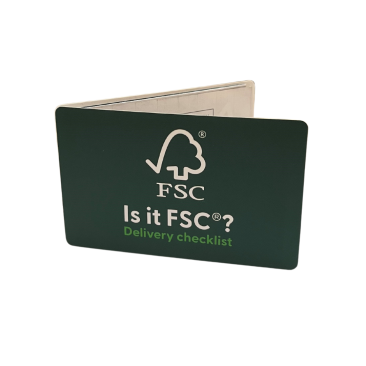
FSC-certified timber, panels and timber products are widely available from leading timber and builders’ merchants, but they don't always carry an FSC label, so how can you ensure that they are FSC certified?
The FSC Chain of Custody and Project Certification standards require procedures to be in place to check the sales and/or delivery documentation which accompanies FSC-certified material. Suppliers of FSC-certified materials must include certain information in sales and/or delivery documents to demonstrate that materials are FSC certified. Our handy pocket-sized checklists are designed to support those checking deliveries of FSC-certified materials. The checklists are free to all UK-based FSC certificate and promotional licence holders. Click HERE to order copies or download a pdf version.
FSC’s values are closely aligned with leading organisations across the construction industry. As committed members of the influential networks below, FSC UK supports industry experts who are driving the sustainable transformation of the built environment.
When it comes to forest-based products, FSC certification is the sustainable choice you can trust to deliver better outcomes for forests, people and markets – today and for future generations.
FSC certification can help to meet legislative requirements, improve market access and help you to implement and evidence your sustainability policies. It allows you to apply FSC labels to your products and make FSC claims in your sales documents (thereby maintaining the chain of custody for FSC-certified products).
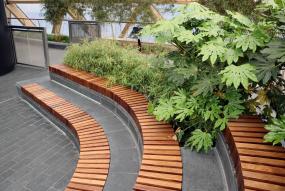
FSC certification is not restricted to products on a shelf. Organisations also have the opportunity to use the FSC trademarks to promote their projects. FSC project certification enables the projects you manage to be FSC certified, allowing you to manage several projects on a continual basis or a one-time project certification, whichever is more convenient for you. Project certification is most often applied to buildings and other temporary or permanent construction projects.
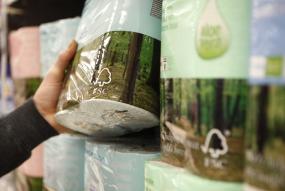
Many suppliers will tell you, often in good faith, that their supplies are from ‘sustainable’ or ‘managed’ sources, or from plantations. But without credible certification there is often no way to know if products have been sourced responsibly.
FSC certification enables businesses and consumers to choose wood, paper and other forest products made with materials from well-managed forests and/or recycled sources.