


Unveiled at the FSC General Assembly, FSC International reported a sharp slide in public concern for climate change, even after the hottest year on record. The 2025 Global Consumer Awareness Survey – conducted with Ipsos across 50 countries and 40,000ch+ respondents – find war and conflict (52%) now dominate public worries while climate change trails at 31%. That is a 21-point gap in the 2025 snapshot. Looking only at the 32 countries surveyed in both 2022 and 2025, the concern gap has widened from 12 points in 2022 – where economic hardship was on top position – to 16 points in 2025.
Global highlights
Forests as the ‘felt’ climate impact: Issues such as loss of species, deforestation, wildfires, droughts and floods remain among the most pressing forestry concerns worldwide, underscoring that people experience climate risk very directly through forests.
Rising concern in key markets: Japan registers a notable increase in climate concern since 2022, while Brazil also moves sharply upward – bucking the global decline.
Attitudes at the checkout: Despite the attention shift, consumers still reward credible sustainability; demand for products that ‘do no harm’ to plants and animals remains strong and continues to influence brand trust and loyalty.
Europe: declining climate concern in key economies
The European results are particularly striking. Across France, Denmark, Spain, the UK and Germany, public concern over climate change has dropped by 6.5–10 percentage points since 2022.
France: 52% → 45% (–7)
Denmark: 51% → 41% (–10)
Spain: 44% → 37.5% (–6.5)
UK: 45% → 35% (–10)
Germany: 42% → 34% (–8)
These countries are among Europe’s largest economies and climate leaders, but public attention is clearly shifting. At the same time, the EU is pushing ahead with ambitious climate legislation – creating a disconnect between policy momentum and public concern.
This concern gap shows why we must work with the concrete realities of people’s lives if we are to address climate change effectively. The survey shows a clear contradiction: people report lower worry about climate change, and yet they reward brands that can prove sustainability. This disconnect between abstract concepts and practical choices points to a clear need: make climate action tangible in daily life.
- Subhra Bhattacharjee, FSC Director General.
Forests remain where people feel climate change most directly
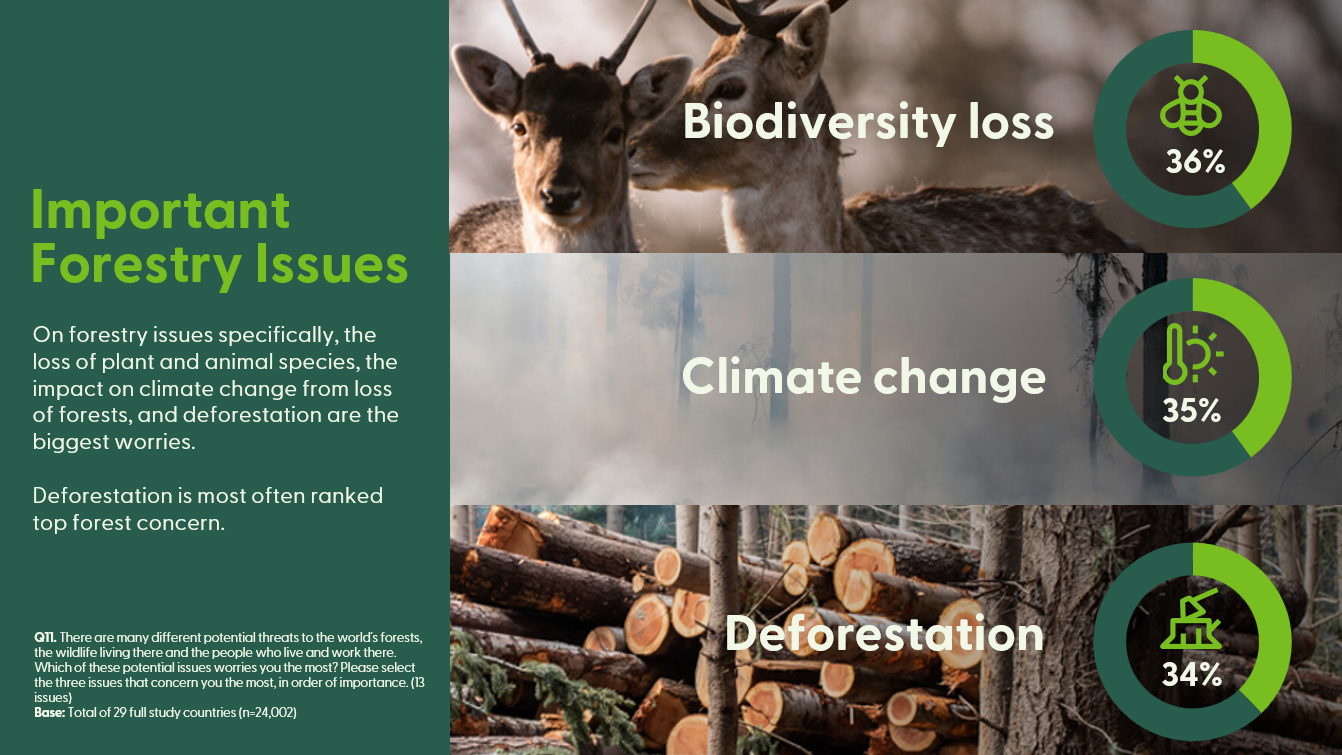
While ‘climate change’ may rank lower as an abstract global issue in the 50-country snapshot, across the forestry module markets the impacts felt through forests –wildfires, droughts, floods, and biodiversity loss – rank among the top concerns within the forestry sector. ‘Loss of plant and animal species’ and ‘deforestation’ consistently appear among the most pressing forestry issues in those markets.
Together, these results reinforce forests’ dual role as frontline climate arenas: they are highly vulnerable to climate change and essential to tackling it.
Consumers still act on climate at the checkout
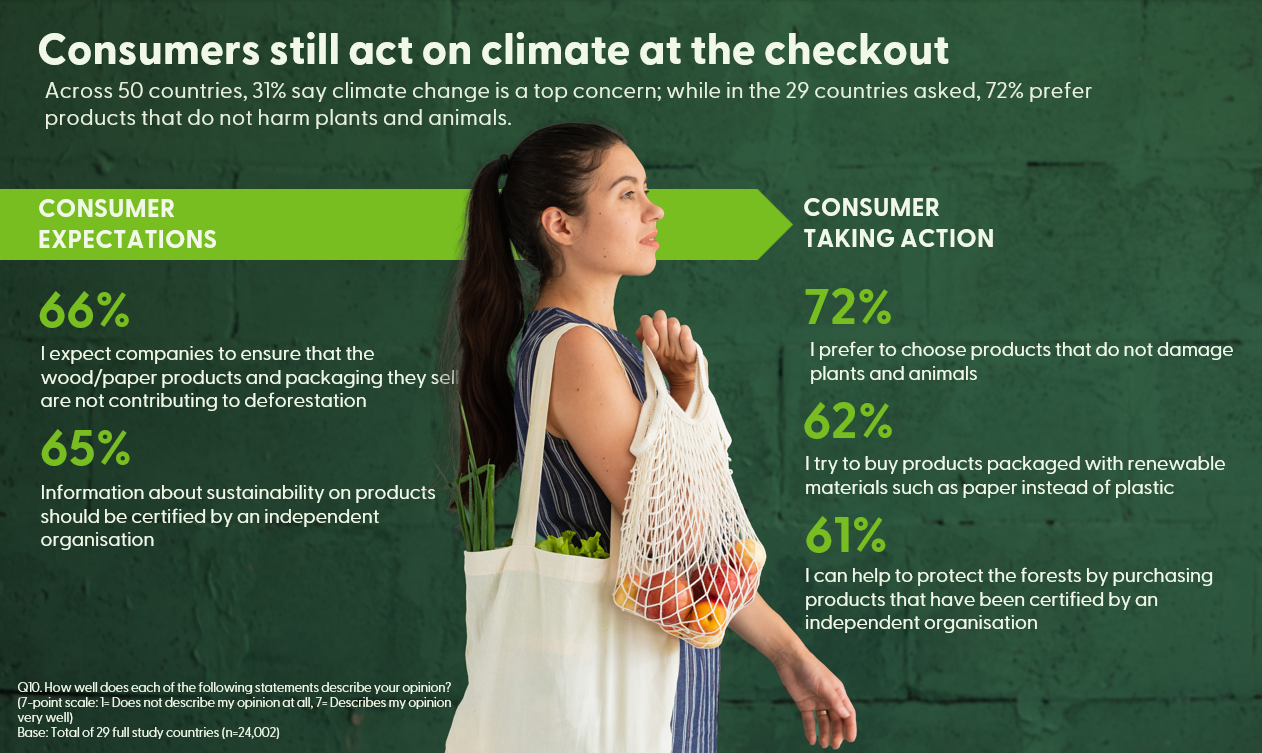
Despite slipping concern levels, consumer behavior reveals strong climate values, with 72% of global consumers across 29 markets saying they prefer products that do not harm plants or animals.
Even if climate change isn’t always top of mind, people are increasingly voting with their wallets. They want sustainable choices – and they reward brands that can prove their impact.
- Helen Chepkemoi Too, Senior Director of Markets at FSC.
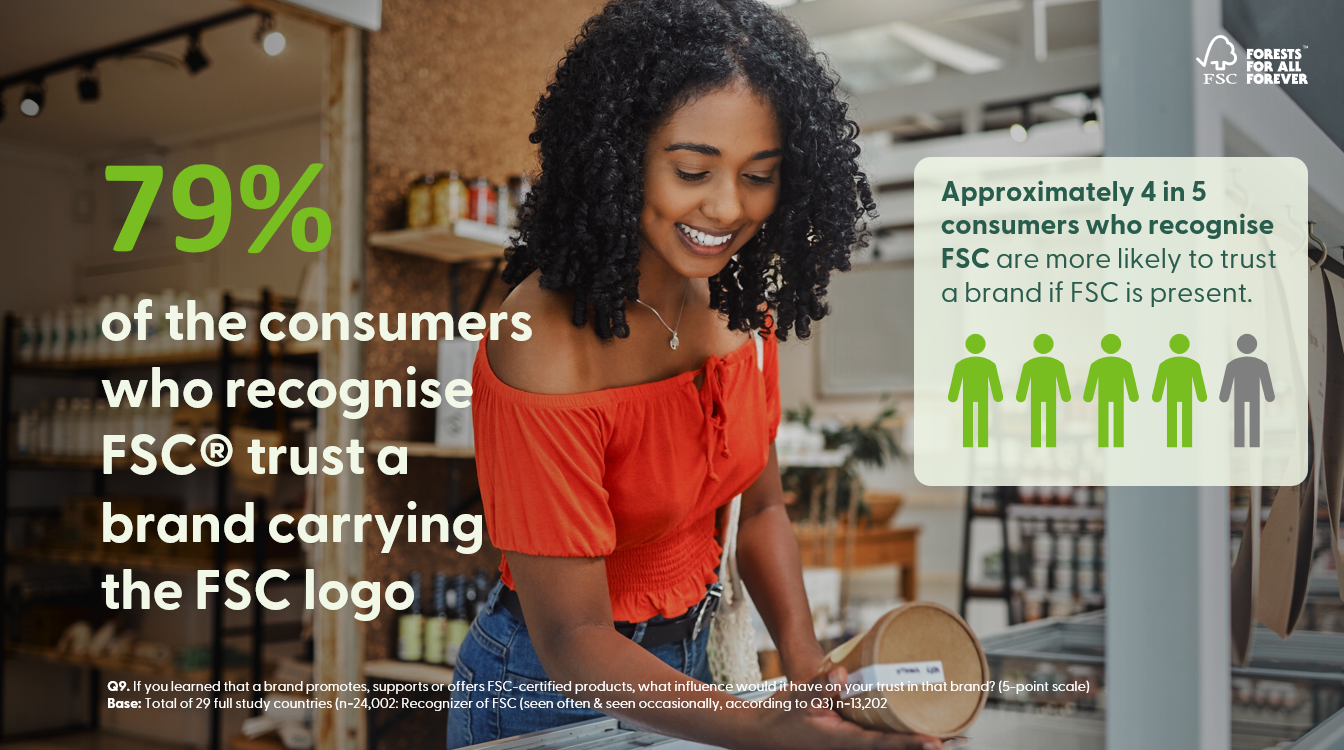
Importantly, recognition of the FSC label correlates with higher levels of trust in brands, showing that climate-conscious choices are a powerful driver of loyalty and reputation.
Why this matters
As wars, pandemics, and inflation dominate public debate, climate change risks sliding out of political and consumer consciousness. Yet at the same time, people clearly want sustainable products and see the loss of plant and animal species as the greatest forestry related concern, with a majority expecting companies to ensure that their products do not contribute to deforestation.
FSC calls for integrated strategies that address environmental action alongside social and economic security – ensuring climate solutions are not deprioritized in the face of crises.
These findings are were debated at the FSC General Assembly (26-31 October 2025), where global stakeholders gathered to shape the future of responsible forest management and its role in tackling climate emergencies.